
# What is the Great Mechanical Fork in the Road on a Stradale Adventure?
The “Great Mechanical Fork in the Road” on a self-drive Stradale Adventure in Morocco represents the critical choice between two distinct vehicle classes for your journey: a nimble, lightweight compact 4×4 or a commanding, ultra-durable full-size 4×4, each offering a fundamentally different driving experience through the Atlas Mountains and Sahara Desert.
There is a distinct moment on every Stradale adventure when the realization of what you have actually signed up for finally hits you. It usually happens about forty-five minutes outside of Marrakech. The chaotic, scooter-swarmed, laws-of-physics-defying roundabouts of the red city have dissolved into your rearview mirror. The horizon suddenly rears up like a jagged wall ofred clay and snow-dusted rock: the High Atlas Mountains. The asphalt begins to tilt upward, twisting into the legendary, serpentine labyrinth of the Tizi n’Tichka pass
At this exact moment, you will look at the steering wheel in your hands, glance at your passenger, and ask yourself a fundamental question: Did I choose the right tool for the job?
When we engineered our self-drive Moroccan itineraries, we explicitly rejected the traditional tourist convoy model. We don’t do radio-linked lead cars, we don’t do mandatory bathroom breaks at pre-arranged souvenir bazaars, and we certainly don’t do hand-holding. The day is entirely yours to command. But while our proprietary navigation app handles the digital trajectory, the physical manifestation of your freedom comes down to a choice between two legendary, yet radically different, engineering philosophies.
In the red corner, weighing in as the scrappy, lightweight undercard champion, is the Compact Dacia Duster. In the blue corner, the undisputed heavy-weight monarch of global overland exploration, sits the Full Size Toyota Land Cruiser or the Volkswagen Toureg.
Both machines will cover the exact same staggering geographic loop—from the jagged heights of the Atlas down to the shifting, wind-sculpted silence of the Saharan dunes. But the way they translate that landscape into your spine, your camera roll, and your sense of adventure is a tale of two entirely different vehicles. Let’s break down the mechanical DNA of your choice, free fromcorporate marketing fluf.
## Why Choose the Compact Dacia Duster for Your Moroccan Road Trip?
Choosing the compact Dacia Duster for your Stradale Adventure provides a lightweight, mechanical, and highly agile driving experience. Ideally suited for the narrow, winding switchbacks of the High Atlas Mountains and graded desert pistes, this fuel-efficient “mountain goat” offers unpretentious charm and easy maneuverability for independent travelers.
To the uninitiated European commuter, the Dacia Duster is a sensible, budget-friendly crossover meant for navigating suburban speed bumps and supermarket car parks. It is the automotive equivalent of a beige cardigan—entirely practical, deeply unpretentious, and unlikely to stir the soul.
But drop that same vehicle onto the high-altitude asphalt of Morocco, and a bizarre, beautiful transformation occurs. The Duster sheds its commuter skin and reveals its true identity: it is an absolutely unkillable, mountain-climbing, piste-shredding mountain goat.
There is a reason why half of Morocco drives a Dacia. It is a vehicle stripped of fragile, overengineered digital vanity. It is light, mechanical, and structurally honest. When you enter the tight, physics-defying switchbacks of the Atlas Mountains, weight is the enemy. The Duster’s compact footprint and low curb mass mean you can place it with absolute millimeter precision on narrow mountain roads where a rogue delivery truck is hogging three-quarters of the lane. It is nimble, incredibly forgiving, and possesses a turning circle that allows you to execute spontaneous U-turns when the navigation app subtly hints that you passed the hidden entrance to an ancient kasbah three hundred meters back.
When the tarmac inevitably ends and gives way to the piste—the wide, graded gravel tracks that cut through the desert valleys—the Duster shines in ways that defy its humble badge. Because it doesn’t weigh three tons, it doesn’t sink into the soft stuff; it skims across it. Its robust, mechanical four-wheel-drive system is wonderfully analog: you twist a dial, the axles lock, and you proceed to bumble happily over washboard gravel and rocky washouts with a cheerful, utilitarian compliance.
The Vibe: The Duster is for the purist. It’s for the driver who smiles at the absurdity of conquering North Africa in a car that costs less than the optional leather package on a German sedan. It feels like a proper, old-school road trip adventure. It’s cozy for ouples, remarkably fuelefficient (meaning fewer encounters with questionable desert fuel pumps), and possesses an unpretentious charm that immediately endears it to the locals. It doesn’t scream “wealthy tourist”; it says “independent traveler who knows exactly what they’re doing.”
## When Should You Choose a Full-Size Toyota Land Cruiser or VW Toureg?
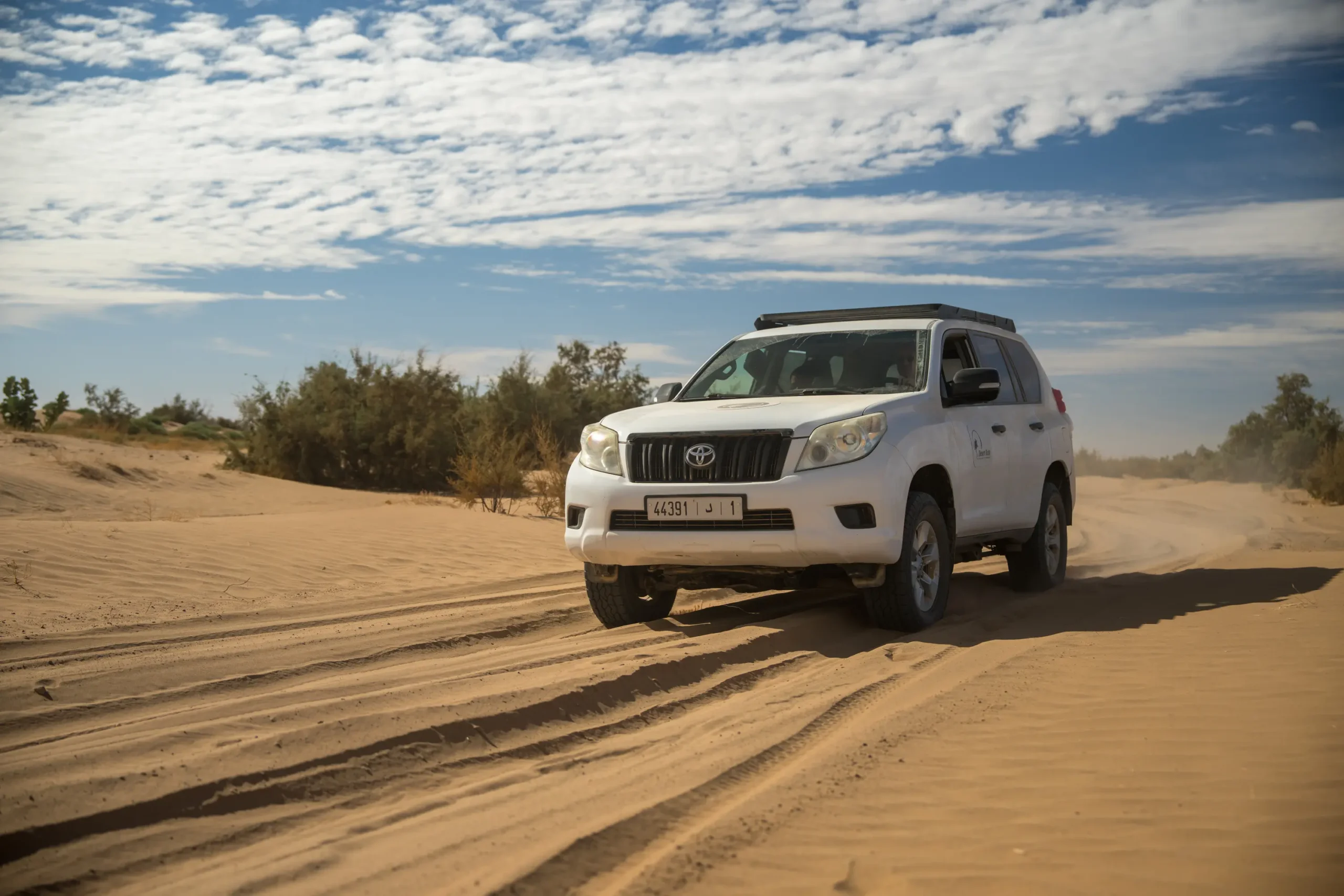
Opt for a full-size Toyota Land Cruiser or VW Toureg if you prioritize first-class comfort, effortless diesel torque, and psychological reassurance. These robust vehicles effortlessly flatten mountain passes, isolate the cabin from rough, corrugated desert roads, and provide an expansive, secure environment for long-distance overland travel.
If the Dacia Duster is a spunky, agile mountain goat, the Toyota Land Cruiser/VW Toureg is an apex predator. They are the absolute gold standard of international diplomacy, remote-area medicine, and heavy-duty overland warfare. Vehicles built with an over-engineered philosophy where failure is not a statistical possibility.
Stepping out of an airplane at Marrakech Menara Airport and walking up to a Land Cruiser or a Toureg is an exercise in immediate psychological reassurance. The vehicle is visually imposing—a vast, chiseled block of engineering that looks like it could comfortably drive through a brick wall and emerge without a scratched bumper.
The moment you climb into the elevated cabin, the world outside becomes instantly less intimidating. The driving position doesn’t just give you a view of the road; it gives you a view of the next postal code. As you navigate the winding mountain passes, these don’t scramble up the hills; they simply flatten them with an immense, effortless wave of diesel torque. The insulation is vault-like. The chaos of localized traffic, the roar of passing heavy transport, and the howling winds of the high passes are reduced to a distant, polite murmur.
But it is on the desert pistes where the Land Cruiser and the Toureg justify itheir legendary status. Corrugated dirt roads—those rhythmic, bone-shaking ridges carved into the clay by heavy trucks—can make a lesser car feel like it is disintegrating from the wheel hubs upward. In these, you don’t feel the corrugations; you hear them as a faint, rhythmic thrumming deep beneath thefloorboards. The massive wheel travel, heavy-duty suspension, and sheer mechanical mass isolate the cabin entirely.
While our Stradale routes are strictly classified as “soft-drive”—meaning we intentionally avoid the vehicle-snapping madness of vertical dune-climbing and deep mud-bogging—having the mechanical overkill of a Land Cruiser or a Toureg creates a massive psychological safety margin. If you accidentally misjudge a dip in a gravel track or encounter an unexpected drift of blown Saharan sand across the highway, these don’t blink. They simply track straight, crush the obstacle, and keep moving forward.
The Vibe: This is first-class overland travel. The Land Cruiser is tailored for those who want maximum space to stretch out, unparalleled long-distance isolation, and an unshakeable sense of mechanical security. It is the vehicle for drivers who want to tackle the wild geography of the Sahara during the day, but arrive at their boutique desert camp looking as crisp, collected, andunflustered as if they had just stepped out of a luxury hotel lobby.
## How Do You Choose the Best 4×4 Vehicle for Your Stradale Adventure?
To choose the best 4×4 for your Stradale Adventure, select the Dacia Duster if you prefer raw mechanical engagement, nimble handling, and lightweight efficiency. Choose the Toyota Land Cruiser or VW Toureg if you desire commanding road presence, vault-like cabin isolation, and maximum space for luxury overland travel.
So, how do you cast your vote at the mechanical ballot box?If your travel philosophy leans toward raw engagement, mechanical simplicity, agility through tight spaces, and a lighter, highly efficient footprint that turns your road trip into a cinematic indie film, lock in the Duster. It will surprise you, it will charm you, and it will go exactly where you point it without a single syllable of complaint.
If, however, your ideal adventure involves a commanding road presence, effortless long-range power, vault-like cabin comfort that leaves the dust and heat entirely outside, and the deep, psychological comfort of knowing you are driving the most reliable four-by-four ever constructed by human hands, upgrade to the Land Cruiser or the Toureg.
Whichever key our team hands you landside in Marrakech, the navigation parameters remain the same: the route is meticulously pre-scouted, the emergency backup infrastructure is fully active, and the horizon is yours for the taking. Choose your machine, turn the key, and let the Atlas Mountains sort out the rest.
Plan Your Stradale Adventure Expedition
Tell us where you're headed — a specialist will be in touch.